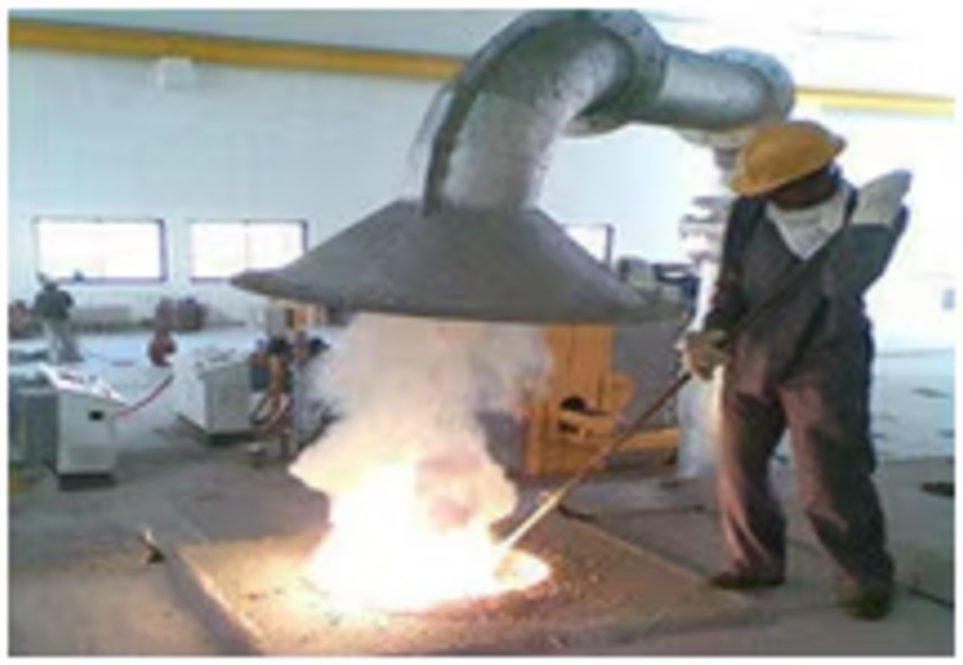
Installing a Fume Extraction System does not automatically guarantee effective contaminant capture. The position of the hood, airflow rate, duct layout, fan selection and discharge arrangement all influence whether fumes are captured before they spread into the surrounding workspace.
For workshops and manufacturing units in Bengaluru, understanding common extraction mistakes can help when planning a new system or investigating poor performance in an existing one.
Mistake 1: Capturing Fumes Too Far From the Source
Source capture is generally more effective when the extraction point is appropriately positioned close to where fumes are generated.
As the distance increases, substantially more airflow may be needed to influence the contaminant plume. Cross-drafts from doors, fans or nearby processes can also pull fumes away from the hood.
Hood placement should therefore be planned around how contaminants actually move.
Mistake 2: Selecting a Fan Without Calculating System Resistance
A fan needs to provide the required airflow while overcoming resistance from the entire extraction network.
Resistance can come from:
Duct length
Elbows and bends
Hoods
Filters
Scrubbers
Dampers
Other treatment equipment
Choosing a fan based only on free-air capacity can result in lower-than-expected airflow after installation.
Mistake 3: Using Poor Duct Layouts
Excessively long duct runs and unnecessary bends can increase pressure losses. Poor duct design may also allow material to accumulate in certain applications.
A practical layout should balance installation constraints with airflow efficiency and maintenance access.
Mistake 4: Ignoring Make-Up Air
Air removed from a building must be replaced.
If a facility extracts large volumes of air without adequate replacement air, unwanted negative pressure can develop. This may reduce extraction performance or cause uncontrolled airflow through doors and openings.
Supply and exhaust requirements should therefore be evaluated together.
Mistake 5: Treating Every Fume the Same Way
Welding fumes, chemical vapours, oil mist and process gases have different properties.
The collection and treatment method should reflect the contaminant. Some applications may require filtration, while others may need wet scrubbing or another treatment method.
Understanding the pollutant is essential before choosing the control equipment.
Mistake 6: Forgetting About Maintenance
Filters load over time. Ducts can become contaminated. Fans and motors require inspection.
If the system is difficult to access, routine maintenance may be delayed. Access points, filter servicing space and equipment clearances should therefore be considered during the design stage.
Improving Extraction in Bengaluru Facilities
Bengaluru's engineering and manufacturing facilities may contain welding stations, chemical processes, fabrication areas and other sources of airborne contaminants. The extraction solution should correspond to the specific source and facility layout.
Vayuvents Private Limited works with fume extraction and industrial ventilation requirements in Bengaluru. A meaningful system assessment considers contaminant characteristics, capture location, airflow, pressure loss and treatment requirements together.
When an existing extraction system performs poorly, simply increasing fan power may not solve the problem. Examining hood placement, duct resistance, make-up air, filter condition and process changes can often reveal the underlying issue. Effective fume extraction starts at the source and depends on every component between the capture point and final discharge.