Strong wind can reduce exhaust, reverse airflow, overload a motor, or drive rain through a discharge hood even when the fan is mechanically sound. You will be able to separate wind pressure from equipment faults, inspect the roof safely, measure the real operating point, and specify a remedy that works at the installed site.
Key takeaways
- Check roof pressure, backdraft dampers, and discharge obstructions before replacing the fan.
- Compare turbine and powered-fan failures instead of applying one troubleshooting method.
- Inspect flashing, curb seals, bearings, wiring, and duct connections after high winds.
- Specify fan pressure, wind loads, weather protection, and roof compatibility together.
How wind pressure defeats a roof fan
Strong wind can reduce or reverse roof-fan airflow because it creates a pressure difference across the fan, not because wind speed simply “slows” the impeller. The first estimate is q = 0.5ρV²: at sea-level air density, 10 m/s produces about 61 Pa and 20 m/s about 245 Pa before roof-specific pressure coefficients are applied.
That pressure can match the available static pressure of an exhaust system.
Wind striking the discharge creates positive pressure at the outlet, opposing the fan’s pressure rise. On the windward side, separated air can recirculate into the hood; ridges, parapets, adjacent buildings, and rooftop equipment add turbulence and uneven velocity. The result is lower airflow, noise, vibration, or reverse flow.
Wind can also enter through a louvre, door, roof opening, or another fan instead of leaving through this fan.
1. Compare airflow direction and fan pressure during calm and gusty periods. A motor drawing normal current does not prove useful exhaust; wind pressure can move the operating point into low flow or stall.
2. Map the installation before blaming the fan. Record roof height, ridge position, parapet height, nearby buildings, equipment, and prevailing wind direction. These determine whether the outlet sits in suction, positive pressure, or recirculation.
3. Treat these wind roof ventilator problems as system-effect issues. Check the hood, damper, curb, and clearances, then compare measured performance with the fan curve at the required pressure rather than with free-air airflow.
Why a turbine and a powered fan show different wind failures
A turbine’s rapid rotation proves only that wind is turning its rotor; it does not prove that air is leaving the building. Blocked replacement-air openings, wind pressure at the outlet, or losses in the roof opening can reduce useful exhaust to almost nothing.
| Equipment | Wind symptom | Decisive check |
|---|---|---|
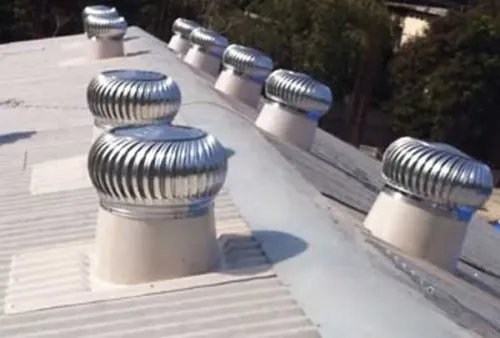
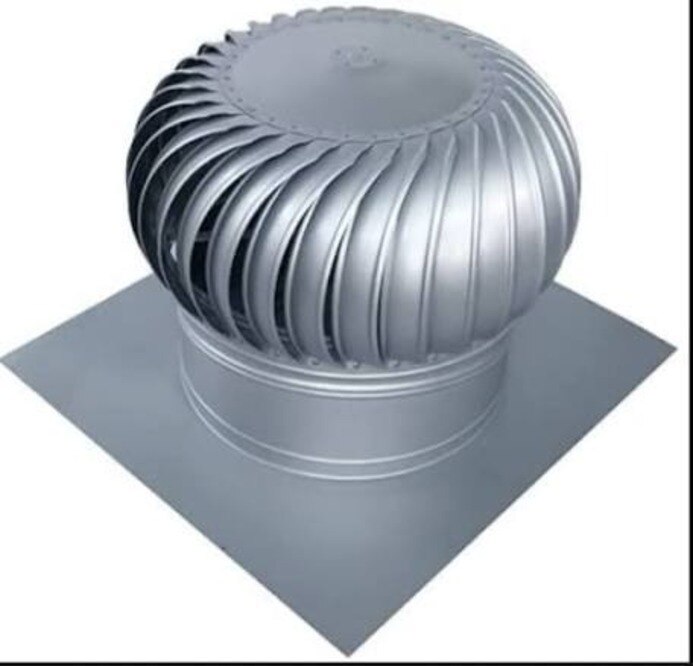
| Wind-driven turbine | Fast rotation with weak, intermittent, or reversed building airflow | Measure airflow direction and pressure at the fan during calm and gusty periods |
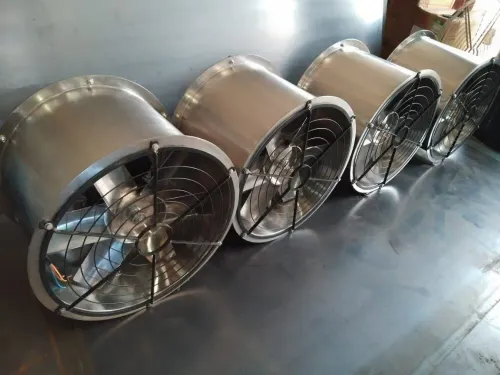
| Powered roof fan | Motor runs, but flow falls during gusts or the motor trips | Check rotation, voltage, current, static pressure, and airflow against the certified fan curve |
Use this test when investigating a roof ventilation fan for problems in windy conditions: measure pressure and airflow direction before blaming the motor. A turbine that spins quickly but produces no pressure difference across the building has a ventilation-path problem, not necessarily a defective rotor.
For a powered fan, inspect the air path before replacing electrical parts. Sealed doors, insufficient make-up-air openings, blocked louvres, or excessive negative pressure elsewhere in the plant can restrict inlet flow and push the fan toward stall. A correct-running motor can still deliver little air.
Map the symptom to pressure conditions:
- Intermittent exhaust during gusts indicates unstable outlet pressure or wind-driven recirculation.
- Reverse airflow indicates external pressure exceeds the fan’s available pressure rise.
- Poor flow with normal motor current points to restricted make-up air or system losses.
- Abnormal current during gusts warrants checks for reverse rotation, damper flutter, or repeated control cycling.
A field sequence for roof ventilation fan troubleshooting
1. Isolate the fan before opening guards or reaching near moving parts. Confirm the control signal, run command, and start frequency, then compare rotation with the arrow on the housing. On a three-phase motor, interchange any two phases only under an electrician’s control; phase reversal can cause low airflow, noise, overload, or reverse flow.
2. Inspect the external condition before changing settings. Check belt tension and alignment, bearings, guards, impeller, screen, hood, fasteners, and visible obstructions. A bent or obstructed impeller causes vibration and noise, while excessive belt tension loads bearings and the motor.
3. Test the non-return damper by hand after isolation. Find a blade that is stuck, dirty, corroded, wrongly oriented, or over-weighted; each can leave the damper partly closed and reduce airflow. A loose blade can flutter in gusts, adding noise, unstable pressure, and repeated motor loading.
4. Measure voltage, phase balance, and current at the motor during the fault, then compare current with the nameplate value. Record static pressure, airflow, and airflow direction in calm conditions and during wind. Check replacement-air openings too: a sealed building can force the fan toward stall, while wind can reverse flow without a mechanical failure.
5. Compare the measured pressure and airflow with the certified fan curve. Investigate operation near stall, damper flutter, excessive belt tension, and repeated control starts before fitting a larger motor; a larger motor can conceal a blocked damper or undersized air path. This roof ventilation fan troubleshooting sequence separates control, mechanical, electrical, and wind-pressure faults.
What to inspect after a high-wind or rain event
A running motor does not prove that a roof fan survived the storm. Wind-driven rain can enter through gaps, joints, cable entries, or the discharge opening, then damage bearings, insulation, terminals, or controls.
| Rain type | What reaches the fan | Inspection concern |
|---|---|---|
| Vertical rain | Falls onto the hood and runs away | A sound hood can shed it |
| Wind-driven rain | Travels sideways or upward through gusts | Rain can enter the discharge opening despite an intact hood |
Isolate and lock out power before opening the fan or touching its internal parts. Check:
- Loose fan, curb, hood, and guard fasteners
- Lifted flashing or separated roof joints
- Torn, compressed, or displaced curb seals
- A cowl shifted out of alignment
- Bent impeller or fan blades
- Cracked welds on the frame, hood, or support
- A displaced guard contacting moving parts
- Cut, abraded, loose, or wet electrical cables
- Water inside the fan housing, terminal box, or motor enclosure
Do not restart the equipment until you find the water-entry path and dry and test affected electrical parts. A wet enclosure can create a short circuit or insulation failure after the motor initially appears to run normally.
Photograph displaced parts and water marks before repair, then recheck rotation, vibration, guards, seals, and drainage under controlled operation.
How to specify a fan that survives the installed roof conditions
Choose the replacement from a certified fan curve at the required static pressure, not from free-air CFM. The operating point must intersect the fan curve and system curve after wind pressure and every component loss are included.
| Basis | What to request | Why it matters |
|---|---|---|
| Free-air CFM | Catalogue airflow at zero static pressure | It ignores wind back-pressure and installation resistance |
| Required-pressure selection | Certified curve at the design static pressure | It predicts delivered airflow at the actual operating point |
| Complete system case | Pressure losses for hood, bird screen, damper, curb, duct, louvre, and roof opening | Missing resistance shifts the operating point left and can cause stall, noise, or overload |
Check system effect around the inlet and discharge. Confirm inlet and outlet clearances, fan throat size, parapet and ridge proximity, the make-up-air path, and the anchorage. A larger hood is not automatically safer; its geometry can intensify recirculation and increase pressure loss.
For an industrial roof fan in Bengaluru, provide roof height, exposure category, parapets, nearby buildings, fan location, monsoon direction, and the IS 875 (Part 3) wind-loading basis. Ask for density-corrected performance at Bengaluru’s elevated site conditions, including pressure, airflow, and motor-power values.
Require a weather-rated discharge arrangement that resists wind-driven rain without choking exhaust. Ask Vayuvents Private Limited, as you would any competing manufacturer, for the certified curve, component pressure-loss data, installation clearances, anchorage details, and commissioning measurements. Compare those documents, not catalogue airflow alone.
Related products
 | The efficiency of Conventional Ventilators is dependent on wind velocity. View product → |
 | Roof Ventilator Electric Roof Top Ventilator Vayuvents Private Limited is India’s leading Industrial Electric Ventilator exporters. |
Frequently asked questions
How does wind pressure defeat a roof ventilation fan?
Wind creates pressure across the fan. At sea-level air density, 10 m/s produces about 61 Pa and 20 m/s about 245 Pa before roof pressure coefficients are applied. Positive pressure at the discharge can reduce flow or reverse it.
Why do turbine ventilators and powered fans fail differently in wind?
A turbine ventilator depends on wind-driven rotation and can stall, overspeed, or allow rain entry when airflow changes. A powered fan can keep rotating while its discharge pressure, backdraft damper, motor load, or airflow becomes abnormal.
What is the correct roof ventilation fan troubleshooting sequence?
Record wind direction and symptoms, isolate electrical power, inspect the fan and damper, check roof penetrations and ductwork, measure airflow or pressure, then test the motor and controls before changing components.
What should you inspect after a high-wind or rain event?
Inspect the fan housing, blades, bearings, motor mount, roof curb, flashing, fasteners, sealant, backdraft damper, electrical enclosure, and signs of water entering the building.
How do you specify a fan for windy roof conditions?
Specify airflow at the required static pressure, design wind speed, roof pressure effects, rain protection, backdraft control, mounting and curb details, corrosion resistance, motor duty, and maintenance access.
Related products
 | Roof Ventilator Get A Clean Environment With Electrically Operated Roof Extractor Fan Electrically Operated Roof Extractor Fan is a device that takes in air from... View product → |
 | Wind Ventilators Manufacturer Powerless Ventilators work on the principle to draw fresh air inside and exhaust overheated and moisture-laden air. |
 | Turbo Ventilators The turbo ventilator is recognized by its inherent nature to utilize the natural force of wind to draw heat and moisture out of the roof . |
 | Roof Ventilator Motorized Roof Ventilation Fans Vayuvents Private Limited manufacturing and exporting high quality Motorized Roof Exhaust Fans worldwide. |