A fan can make a hot workstation feel more tolerable without lowering the factory’s dry-bulb temperature, especially when the building has no planned route for hot air to leave. By the end, you will be able to distinguish fan types, estimate the airflow and pressure you need, plan an effective inlet-to-exhaust path, and judge whether a tunnel fan is safer and more economical than another cooling method.
Key takeaways
- Separate air movement from heat removal before selecting equipment.
- Size airflow for the occupied zone, not the entire building volume.
- Use exhaust relief and make-up air to prevent short-circuiting.
- Check Mumbai humidity, monsoon exposure and electrical safety before purchase.
What a tunnel fan is—and where its cooling benefit comes from
A tunnel fan is an airflow arrangement for moving air along a long industrial space, not a specific fan geometry. As a large area cooling fan, it delivers a directed jet toward occupied work zones; “tunnel fan for factories” describes this application.
| Term | What it describes | Practical use |
|---|---|---|
| Tunnel fan | Application and airflow arrangement | Long, directed air movement through a work area |
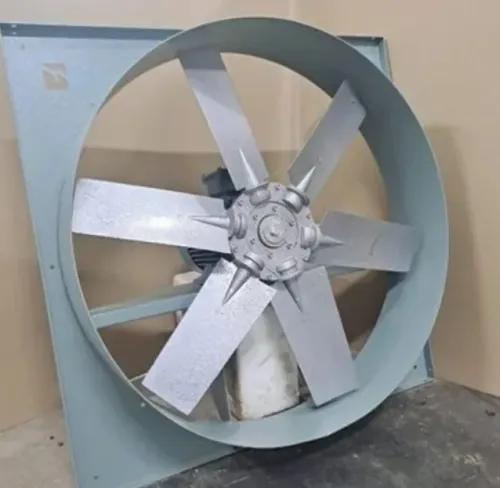
| Tube-axial fan | Fan geometry: an axial impeller inside a cylindrical casing | High-volume air delivery through a straight path |
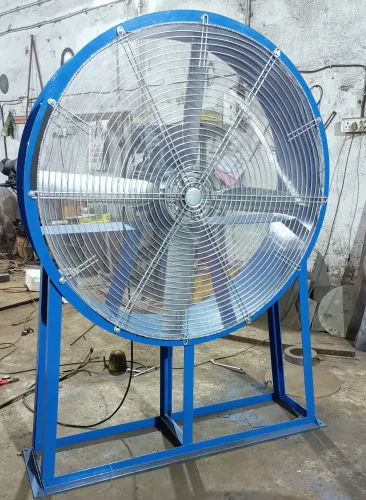
| Tubular mancooler | Portable, directional tube-axial arrangement | Spot cooling beside furnaces, casting lines or welding stations |
| Centrifugal blower | A rotating wheel turns air through a scroll | Higher pressure for resistance from ducts, filters or process equipment |
The main tunnel fan benefits for industrial cooling come from air speed, not a large drop in dry-bulb temperature. A long jet can reach workers, increase air movement at worker height, disrupt hot-air stratification and push heat toward a roof exhaust or wall outlet.
Do not treat free-airflow capacity as useful airflow at the workstation. Throw distance, mounting height, obstructions, residual air speed and recirculation determine whether workers feel the jet. A fan rated at free-air m³/h can perform poorly if partitions stop the stream or the discharge circulates above the occupied zone.
Decide whether you need air movement or actual heat removal
A large area cooling fan improves comfort by increasing air speed across skin, strengthening convective heat transfer and sweat evaporation. It does not materially lower dry-bulb temperature in a sealed factory, remove radiant heat from furnaces, roofs or hot process surfaces, or make severe heat exposure safe.
Use this decision path:
1. For accumulated hot air, design exhaust with intentional make-up air through roof exhausters, wall louvers or dedicated openings. Without replacement air, exhaust performance falls and fans can draw contaminants from unwanted areas.
2. For welding fume, solvent vapour or dust, use local exhaust ventilation at the source. A tunnel fan can spread contaminants through the breathing zone instead of protecting workers.
3. Consider evaporative cooling only after checking entering dry-bulb temperature, relative humidity, required leaving condition, water quality, drift control and microbial-control requirements. Humid coastal air limits sensible cooling.
4. Specify mechanical refrigeration when the building requires a controlled temperature, not merely improved air movement.
Assess comfort using occupied-zone air speed, radiant heat, humidity, clothing, workload, acclimatization and work-rest arrangements. Use WBGT for heat-stress assessment; do not treat fan horsepower as a safety measure. The tunnel fan benefits for industrial cooling exist only when the jet reaches workers without worsening heat or contaminant exposure.
Size and place a tunnel fan around the occupied zone
Calculate a preliminary airflow from room volume and air changes per hour, then test that result against internal heat load, worker locations and the target air speed at worker height.
Air changes alone cannot size a factory cooling system: a large area cooling fan with high volume can miss the occupied zone or fail against furnace heat and radiant surfaces.
Select a tunnel fan for factories from its performance curve at the required static pressure, not its free-air m³/h or m³/s rating. Include pressure losses from louvers, filters, screens, silencers, transitions and discharge openings; the delivered airflow at the workstation is what matters.
Plan a straight inlet-to-exhaust route. Place fans so the jet reaches workers, not their backs, an overhead void or a blocked aisle, and keep partitions and stacked goods out of the discharge path. Provide intentional relief through roof exhausters, wall louvers, doors or dedicated openings.
Use this layout checklist:
- Map worker stations, heat sources, partitions, storage racks and the occupied height.
- Mark the inlet, fan positions and exhaust openings so air travels across the work area.
- Check throw and residual air speed at each workstation, not only the fan’s catalogue rating.
- Prevent short-circuiting: an open door beside the fan or a badly placed exhauster can pull fresh air straight out, leaving hot stagnant zones elsewhere.
- Recheck temperature, humidity and air speed after installation, then adjust fan spacing or speed.
Compare tunnel fans with other large-area and spot-cooling options
A tunnel fan suits long, open airflow paths; a spot unit suits one hot workstation. Compare the installation against the actual reach, pressure and heat-removal need.
| Option | Reach and direction | Pressure, noise and installation | Heat and humidity effect |
|---|---|---|---|
| Tunnel fan for factories | Long, directional jet along a work area | Medium pressure; motor, supports and exhaust path required; noise depends on speed | Moves air and heat; does not cool sealed air |
| HVLS fan | Broad, downward circulation | Low pressure, large motor; fixed structural installation | Redistributes air; no heat removal |
| Pedestal fan | Short, adjustable spot airflow | Low pressure, portable, noisy near workers | Redistributes air only |
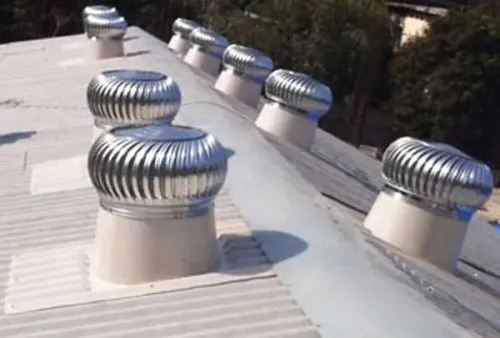
| Roof ventilator | Upward exhaust at roof level | Low pressure; roof penetration and weatherproofing required | Removes accumulated hot air if make-up air enters; no humidity control |
| Evaporative cooler or air washer | Directed or broad supply air | Medium pressure; water, drainage and cleaning required | Lowers dry-bulb temperature but raises humidity |
| Spot cooler | Local ducted cold-air delivery | Higher pressure, hoses and condensate handling; audible | Removes heat locally; adds refrigeration load |
| Air-conditioning | Controlled, building-wide supply | High pressure and power; costly installation and maintenance | Removes sensible heat and moisture |
The tubular mancooler fan benefits are concentrated airflow beside a furnace, casting line or welding station, simple relocation and lower installation effort. Check throw distance, residual air speed, guard safety, motor enclosure, maintenance access and continuous-duty rating.
Wheels or stands may fail on uneven floors; guards can restrict the jet, and moving the unit requires labour and cable management. One unit cannot ventilate a whole building or safely disperse welding fume.
Specify, operate and verify the fan safely and economically
Before approving a tunnel fan for factories, demand a signed schedule showing the duty point, fan curve, fan diameter, motor rating, enclosure, impeller material, speed-control range, sound level, operating limits, warranty, spare-parts list, maintenance intervals and commissioning procedure. Free-air volume alone cannot prove the claimed tunnel fan benefits for industrial cooling.
- Fit guards to every rotating part, provide electrical isolation for maintenance, verify earthing, protect cable routes, and keep emergency access clear.
- Check exposure to dust, moisture, salt and chemicals before selecting the enclosure, materials and drainage arrangement.
- Do not use a normal cooling fan for smoke extraction or fire mode without the tested fire rating, controls, power supply and system design.
| Check | Compare or measure | Failure exposed |
|---|---|---|
| Motor energy | Motor rating, duty cycle and variable-speed operation | Oversized motor or unnecessary full-speed running |
| System resistance | Pressure losses through grilles, filters, screens and openings | High energy use at reduced airflow |
| Cleaning | Blade, guard, filter and intake fouling at each maintenance interval | Fouling that masks declining performance |
| Occupied zone | Air velocity, temperature, humidity and noise before and after installation | Poor comfort despite high airflow |
| Commissioning | Make-up and exhaust paths, motor current and vibration | Short-circuiting, overload, imbalance or loose mounting |
| Final inspection | Airflow after cleaning and worker noise exposure | Turbulence, bearing wear or unsafe operating conditions |
Use a Mumbai-specific checklist before choosing an industrial tunnel fan
Before approving an industrial tunnel fan in Mumbai, inspect monsoon moisture, coastal salt, dust and chemical contamination at the installation point. Check drainage, corrosion-resistant construction, protected electrical equipment, available voltage and phase, lifting access, structural supports, wall or roof penetrations, weather protection and local service response.
Use this checklist for a tunnel fan for factories:
- Ask for delivered airflow at the specified static pressure, not only horsepower or free-air m³/h.
- Require sound level, vibration, motor current and occupied-zone air velocity at the proposed duty point.
- Confirm cleaning access, replacement-parts availability, commissioning responsibility and after-sales support.
- Reject airflow that could spread solvent vapour, welding fume or dust; use source-capture exhaust instead.
| Proposal check | Accept | Reject |
|---|---|---|
| Layout | Fan placement linked to make-up air and exhaust | Fan shown without an airflow path |
| Electrical data | Voltage, phase, protection and current stated | Motor rating only |
| Installation | Supports, lifting route and penetrations detailed | Site access assumed |
| Service | Response contact and spare-parts plan | No local support |
Vayuvents Private Limited can be compared with other suppliers when its proposal supplies these measurable documents and site-specific layout.
Related products
 | Industrial Man-cooler Fan - High Quality, Durable and Long-Lasting The purpose of an industrial man cooler fan is to keep workers in a cool... View product → |
 | The overpowering heat in an industrial work place can bring down the efficiency and productivity of workers. View product → |
Frequently asked questions
What is a tunnel fan, and how does it cool a factory?
A tunnel fan arrangement moves a directed air stream along a long industrial space. It improves perceived cooling by increasing air velocity over workers and equipment, but it removes heat only when hot air is exhausted and cooler replacement air enters.
How do you know whether you need air movement or actual heat removal?
Measure indoor and outdoor temperature, humidity, heat sources, exhaust airflow and worker exposure. Choose air movement when the main problem is stagnant air; add exhaust, make-up air or mechanical cooling when the building retains heat.
How should you size and place a tunnel fan?
Define the occupied zone, airflow direction, fan-to-fan spacing, intake path and exhaust outlet. Keep the jet clear of obstructions, prevent recirculation and verify air velocity at worker height rather than relying only on rated fan airflow.
How does a tunnel fan compare with spot cooling or a tubular mancooler fan?
Tunnel fans suit long, open areas that need directional airflow. Tubular mancooler fans provide focused air at a workstation, while evaporative or refrigerated systems provide stronger cooling when humidity, process heat or outdoor conditions limit air-movement benefits.
What should you check before choosing an industrial tunnel fan in Mumbai?
Check monsoon water exposure, corrosion protection, drainage, electrical enclosure rating, available power, noise, maintenance access and the building's make-up-air route. Confirm the layout with the supplier and test airflow during representative operating conditions.
Related products
 | Mancooler has longer life and durability to work in extreme Industrial Conditions. View product → |
 | Belt Driven Tube Axial Flow Fan Axial Flow Fan – Modern Industrial Equipment Required For Cooling And Air Supply Needs An Axial flow fan takes in air parallel to the axis of blades... View product → |