A tunnel fan moves air across a workshop, while a roof extractor removes air through a defined roof opening; neither choice is safe by comparing catalogue airflow alone. You will be able to match the fan arrangement to fume-capture needs, calculate the duty point, and account for Mumbai’s rain, humidity, wind, corrosion and neighbouring buildings.
Key takeaways
- Use local fume extraction before relying on room air movement.
- Compare fans at the system duty point, not free-air capacity.
- Choose roof extraction only with a deliberate replacement-air path.
- Commission airflow, controls and safeguards before welding production begins.
What each fan actually does inside a welding shop
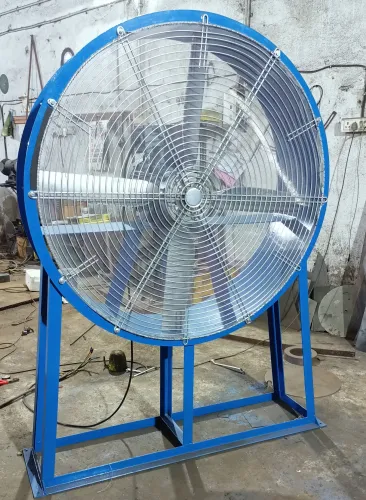
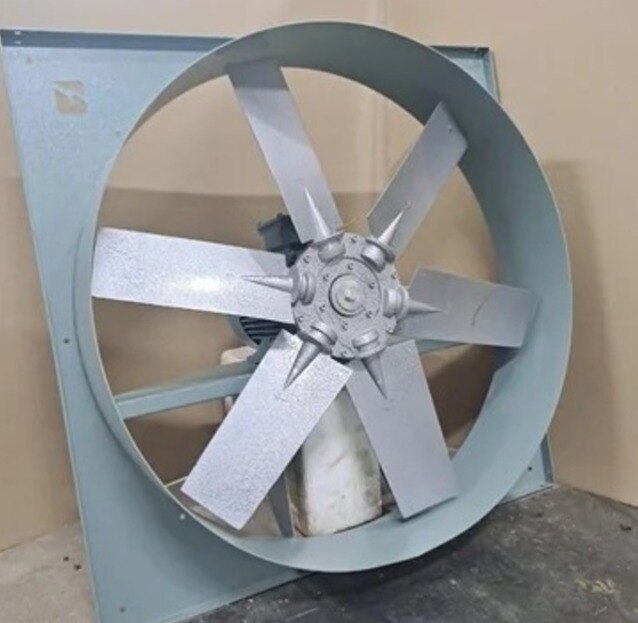
A tunnel or jet fan creates thrust and longitudinal air movement by entraining surrounding room air. It circulates a moving air mass; it is not a guaranteed building exhaust unless exhaust points receive that flow. A roof extractor removes air through a roof penetration and needs a defined replacement-air path.
Equal nominal m³/h ratings do not mean equal performance: compare tunnel-fan thrust, jet velocity, throw and room-air pattern with roof-fan airflow at system resistance.
| Option | What it does | Practical consequence |
|---|---|---|
| Tunnel or jet fan | Usually axial; low static-pressure device mounted inside the shop | Covers a longitudinal zone, but jet noise reaches workers and contaminated air can be redistributed |
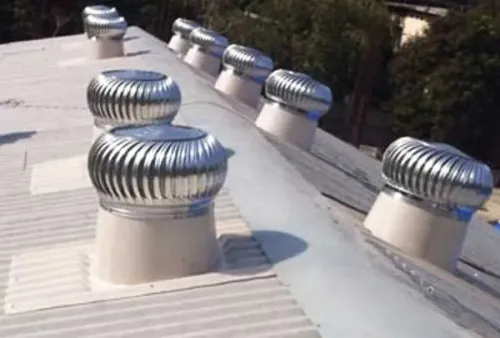
| Roof extractor | Point exhaust, usually axial at low resistance or centrifugal for ducts, filters and higher static pressure | Covers its inlet area; roof cowl, duct, screen, filter and discharge losses determine delivered airflow |
| Installation | Tunnel fan needs supports and electrical supply; roof fan needs penetration, weatherproofing and safe roof access | Roof work costs more initially and creates leakage and rain risks |
| Maintenance | Tunnel units provide motor access; roof units require roof access, with belts, bearings and weather seals to inspect | Access equipment and downtime affect ownership cost |
| Energy and cost | Tunnel power moves air; roof extraction also creates make-up-air demand and possible heating or cooling load | Select from the duty point, not free-air m³/h |
This industrial exhaust fan comparison does not replace source capture: a hood or extraction arm belongs near the welding arc. Never place a jet behind a welder where it can push fumes across the breathing zone.
Protect the welder before you move air around the room
Neither a tunnel fan nor a roof extractor controls welding fume at the arc. Use a capture hood, articulated extraction arm, downdraft table or other local exhaust ventilation as close to the arc and plume as practicable; roof-level dilution can let fume pass through the welder’s breathing zone.
1. Place the hood where it intercepts the plume without obstructing the weld. Eliminate cross-draughts from doors, shutters and fans; a crossflow can pull fume past the hood before capture. Never place a tunnel fan behind a welder: its jet can push contaminated air directly across the face.
2. Arrange make-up air on the worker’s clean side, then direct it toward the hood and exhaust point. Do not introduce replacement air behind the plume or sweep fumes through occupied bays. Use smoke testing to confirm the path with normal doors and shutters.
3. Use a roof extractor for general clearance after welding, especially where hot residual air rises, but never as the primary control—even for mild-steel work. Source capture remains necessary.
4. Before selecting the fan, duct, collector or electrical equipment, assess stainless steel, coatings, oily parts, solvents, aluminium, reactive materials and combustible dust. These materials can create fire, explosion or compatibility hazards that demand a specialist review.
This source-first sequence is essential for welding shop ventilation in mumbai: move room air only after protecting the person at the plume.
Calculate the duty point instead of buying the free-air rating
A duty point converts the workshop problem into a fan specification; a catalogue free-air rating does not.
1. Measure the room: length × width × height = volume in m³. Select a documented air-change basis for residual dilution, then calculate airflow as volume × ACH in m³/h. Treat ACH as a supplement, not the design answer: fume generation, welding hours and local-capture requirements take priority over an arbitrary figure.
2. Calculate total resistance in pascals (Pa), including duct length, elbows, hoods, roof cowls, weather louvres, bird screens, filters and discharge losses. Include the collector’s dirty-filter pressure, not only its clean-filter value; loading can reduce capture unless you specify a differential-pressure alarm, inspection access and a cleaning or replacement plan.
3. Plot the system curve against the fan performance curve. Their intersection is the duty point. At that point, check airflow, total pressure, efficiency, motor rating and sound level. This is the useful basis for an industrial exhaust fan comparison: construction type matters less than verified performance on the actual system.
4. Record doors and shutters in both operating states. Openings alter resistance, short-circuit the intended sweep and change make-up airflow.
5. Provide a defined inlet path for a roof extractor. Without replacement air, the building becomes excessively negative: delivered airflow falls, doors become difficult to operate, and air enters through contaminated gaps. Recheck the duty after installation, with filters loaded and normal openings set.
Choose tunnel movement, roof extraction or both in Mumbai
Use a tunnel fan versus roof extractor fan in Mumbai by matching the airflow objective, not the catalogue m³/h. Choose a tunnel fan in Mumbai only for a tested longitudinal sweep or controlled dilution pattern, with workers outside the contaminated jet path and exhaust points positioned to receive the flow.
Choose a roof extractor fan in Mumbai when buoyant hot air and residual fume rise toward the roof and a deliberate make-up-air route supports extraction.
| Option | Use it when | Main failure |
|---|---|---|
| Tunnel fan | Smoke testing, airflow modelling or measurements confirm a protected sweep | The jet pushes fume across a welder’s face or redistributes it |
| Roof extractor | Rising heat and fume can reach the roof through a planned replacement-air path | Air enters through random gaps, reducing flow and increasing negative pressure |
| Both | Local exhaust serves welding stations, roof exhaust clears the room and testing validates movement | The tunnel fan undermines capture or sends discharge toward occupied areas |
Keep a capture hood, extraction arm or downdraft table close to every arc. General roof dilution cannot replace source capture. Never assume wind-assisted extraction: inspect neighbouring buildings, changing wind direction and discharge re-entry through doors, windows and air intakes.
Check monsoon rain at the penetration and cowl, roof leakage, coastal salt corrosion on fasteners and motors, high ambient temperature, and dense surrounding construction. Vayuvents Private Limited can contribute as a Mumbai-based manufacturer and commissioning partner when it documents duty point, construction, discharge location and site design instead of offering generic performance claims.
Related products
 | Get A Clean Environment With Electrically Operated Roof Extractor Fan Electrically Operated Roof Extractor Fan is a device that takes in air from... View product → |
 | Roof Ventilation Fan Vayuvents Private Limited manufacturing and exporting high quality Roof Exhaust Fan worldwide. |
Verify installation, operating cost and safe commissioning
1. Compare the installed system with the design duty point: measure airflow and static pressure, confirm fan rotation and motor current, then inspect vibration and noise. Record the readings, instrument details and acceptance limits.
2. Use smoke at welding stations to verify plume capture and room sweep. Record make-up-air paths with doors and shutters in normal positions; an open shutter can hide poor capture or create a cross-draught across the welder’s face.
3. Inspect the roof seal, cowl and flashing for rain ingress. Check corrosion-resistant fasteners, motor housings and electrical enclosures, especially for a roof extractor fan in Mumbai, where monsoon rain, humidity and salt accelerate failures.
4. Confirm safe access for bearing or belt service without unsafe roof work. Fit filter differential-pressure monitoring, set an alarm point, and document cleaning or replacement intervals based on pressure rise and operating hours.
5. Calculate ownership cost as energy plus replacement filters, access equipment, downtime, roof repairs, make-up-air heating or cooling and premature corrosion. A cheap fan can become expensive when every service requires a crane or production shutdown.
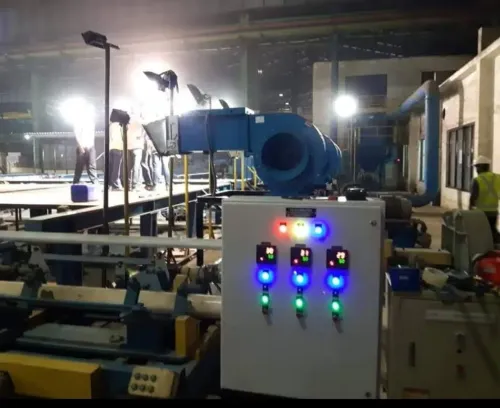
6. Interlock welding equipment with local exhaust where the process depends on capture. Define the response to fan or collector failure: stop welding, alarm locally, isolate the process, and restart only after airflow is proven.
Do not select standard equipment for solvent vapour, combustible dust, oily residues or reactive metals until fire, explosion and material-compatibility reviews are complete. The welding shop ventilation in Mumbai should be documented, capture at the arc, discharge safely and prove acceptable airflow after installation.
Frequently asked questions
What does a tunnel fan do in a welding shop?
A tunnel or jet fan creates thrust and longitudinal air movement by entraining surrounding room air. It circulates air but does not guarantee building exhaust unless exhaust points receive that flow.
What does a roof extractor fan do?
A roof extractor removes air through a roof penetration. It needs a defined replacement-air path so the shop does not operate under excessive negative pressure.
Should welding shops use tunnel fans instead of local fume extraction?
No. Protect the welder at the source with suitable local extraction before using tunnel fans or roof extractors for general room ventilation.
How do you compare fan capacity for a welding shop?
Compare each fan at its system duty point, including airflow, static pressure, duct resistance, roof terminal losses, filters and replacement-air resistance. Do not use the free-air rating alone.
When should a Mumbai welding shop choose a tunnel fan, roof extractor or both?
Choose tunnel movement when you need controlled longitudinal circulation, roof extraction when you have a clear discharge and replacement-air path, and both when the airflow layout connects circulation to effective exhaust.
Related products
 | The efficiency of Conventional Ventilators is dependent on wind velocity. View product → |
 | Roof Ventilator Electric Roof Top Ventilator Vayuvents Private Limited is India’s leading Industrial Electric Ventilator exporters. |
 | Roof Ventilator Motorized Roof Ventilation Fans Vayuvents Private Limited manufacturing and exporting high quality Motorized Roof Exhaust Fans worldwide. |