A tunnel greenhouse needs more than a large fan: the inlet, crop zone, shutters, screens and exhaust duty must work as one airflow path. By the end, you will be able to choose the ventilation arrangement, estimate required airflow, compare fan performance at pressure, and prepare a practical specification for Bengaluru conditions.
Key takeaways
- Use low-level inlets and opposite-end fans for a continuous tunnel airflow path.
- Compare exhaust-only, tunnel, and mixed ventilation against crop and structure needs.
- Size fans for required airflow at system pressure, not free-air capacity alone.
- Use staged controls to manage temperature and humidity during Bengaluru weather changes.
How a tunnel ventilation path moves air through the crop
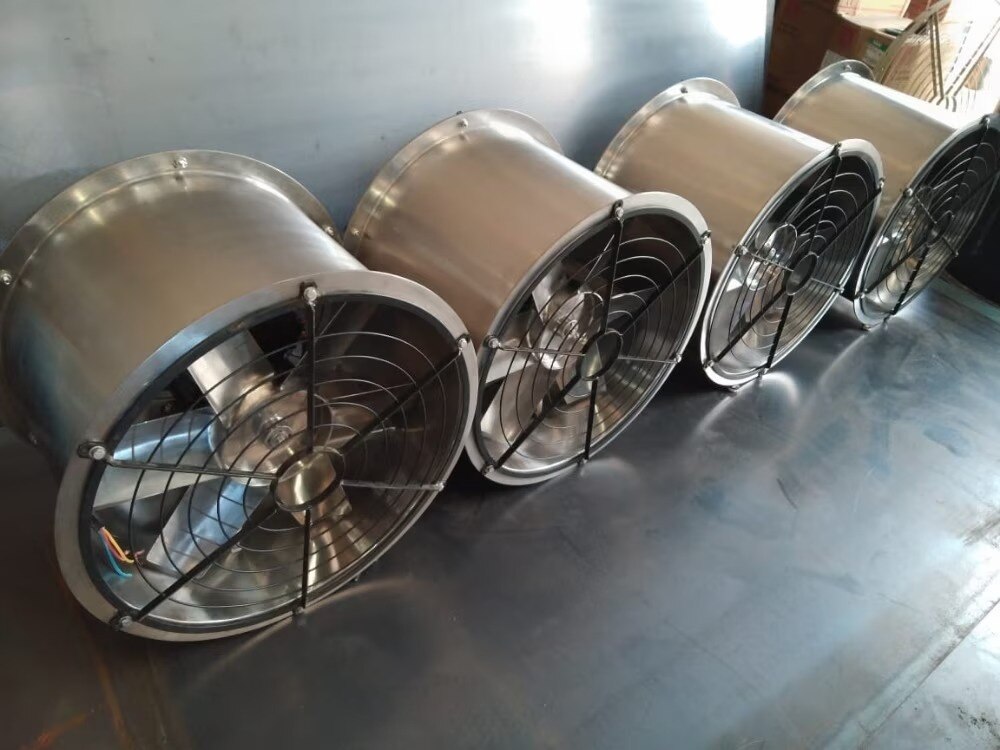
Greenhouse tunnel fan ventilation works as a one-way path: low-level inlets, shutters, or evaporative pads admit outside air at one end, and exhaust fans at the opposite end pull it through the crop zone. Mounting fans high on the end wall removes hot upper air without abandoning airflow around the canopy.
An inlet beside an exhaust fan creates short-circuiting: fresh air exits before it crosses the plants. Random fan placement creates competing paths, leaving sections stagnant while other areas receive excessive velocity. A long tunnel also loses movement through leakage, friction, and inlet resistance, so total rated airflow does not prove uniform crop ventilation.
Use this installation checklist:
- Distribute fans across the end wall rather than clustering them; size spacing and wall clearances from the fan manufacturer’s required inlet and discharge clearances.
- Keep crop rows, trellises, walls, and structural members clear of fan inlets and discharge cones so they do not obstruct the path.
- Spread opposite-side inlets across the tunnel width and keep them low enough to drive replacement air through the canopy.
- Seal fan frames, shutters, pad edges, and unused openings; leakage lets air bypass the crop.
- Check air speed, leaf movement, temperature, and humidity at crop height at several points along the tunnel, then compare them with ridge-level readings.
- Select an industrial exhaust fan for greenhouse service using delivered airflow at operating static pressure, including pads, screens, louvers, shutters, and dirt—not its free-air catalogue figure.
Choose exhaust-only, tunnel, or mixed ventilation for the crop and structure
Exhaust-only ventilation fits a compact or irregular greenhouse that needs air replacement without forcing air through a long, controlled path. Choose tunnel ventilation for a long house with a defined inlet bank at one end and exhaust fans at the opposite end, so air crosses the crop zone instead of escaping through the nearest opening.
| Option | What it does | Best fit | Main limitation |
|---|---|---|---|
| Exhaust-only fans | Replaces indoor air through nearby inlets | Short houses and simple heat removal | Uneven airflow in long or dense crops |
| Tunnel fans | Pulls air from an inlet bank across the crop | Long houses requiring a directional path | Needs balanced inlets and adequate fan pressure |
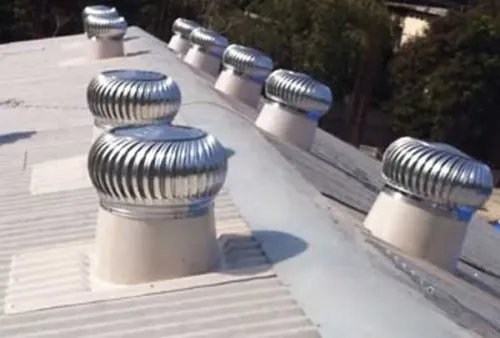
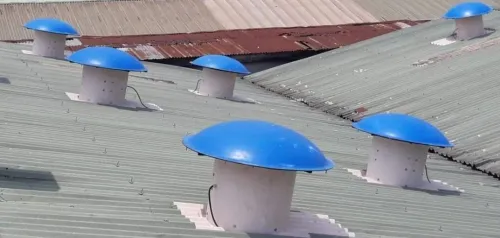
| Roof extractors | Remove rising heat near the ridge | Local heat relief or supplemental extraction | Do not create reliable end-to-end crop airflow |
| Centrifugal blowers | Deliver pressurised air through ducts or restricted inlets | Ducted layouts and higher-resistance systems | More complex installation and control |
| Pad-and-fan system | Draws incoming air across wetted pads before exhausting it | Hot, dry conditions requiring cooling | Cooling falls as outdoor wet-bulb temperature approaches dry-bulb temperature |
Add circulation fans to create a mixed system when the tunnel path leaves dead spots, stratifies heat, or fails to move air through dense foliage. They redistribute air; they do not replace correctly sized exhaust fans and inlets.
For tunnel fan applications in Bengaluru, use pad cooling most aggressively during hot, dry pre-monsoon weather. Humid monsoon air offers little evaporative cooling, and humid nights can worsen condensation; temperature-plus-humidity or dew-point control is safer than temperature alone.
Calculate airflow from greenhouse volume, crop velocity and system pressure
Start with greenhouse volume: length × width × average internal height. For one complete exchange per minute, use Q = volume × 1 per minute, equal to about 60 air changes per hour.
Cross-check that result against the hot-condition guide of 8–10 CFM per square foot of floor area, then adjust for crop density, glazing, solar load and Bengaluru weather.
Check crop-zone movement separately. Calculate Q = tunnel cross-sectional area × the selected air velocity through the crop, then use the larger defensible duty where volume turnover and crop-flow calculations differ. Convert the final airflow: 1 m³/h equals approximately 0.589 CFM, and 1 CFM equals approximately 1.699 m³/h.
For an industrial exhaust fan for greenhouse tunnel fan ventilation, select delivered airflow at operating static pressure, not free-air catalogue capacity. A single large fan is not automatically better; several fans provide staged capacity, redundancy and more even tunnel airflow.
- State the required delivered airflow in m³/h and CFM.
- Add pressure losses from evaporative pads, insect screens, louvers, transitions, ducting, shutters and dirt-loaded components.
- Ask for the fan curve showing the duty point in Pa, motor input, efficiency and delivered airflow.
- Compare blade diameters only at the same pressure and duty point; catalogue CFM alone is not comparable.
- Recheck the result for long tunnels, because leakage and friction reduce air movement at the far end.
Set fan locations and controls for temperature, humidity and Bengaluru weather
Set the first exhaust fan bank high on the end wall, with its inlet area on the opposite end matched to that bank. Add stages progressively along the inlet opening; switching on a large bank against a small opening raises air speed and pressure, while an undersized inlet starves the fans.
Use continuous operation only when the crop needs a steady air exchange. For lighter loads, stage fan banks instead of starting every motor together. Match each stage to its inlet area and temperature setpoint so mild conditions do not cause leaf drying, excessive transpiration or unnecessary electrical demand.
A variable-frequency drive can trim airflow between stages, but confirm that the motor and fan are rated for speed control.
| Hot, dry pre-monsoon weather | Use thermostat or temperature-controller stages; pad cooling can work while outside wet-bulb temperature remains well below dry-bulb temperature. |
|---|---|
| Humid monsoon weather | Add humidistat or dew-point logic; exhausting hot air will not cool the crop if outside air is hotter, and ventilation will not lower humidity when incoming air has higher absolute moisture. |
| Cooler humid nights | Prevent temperature-only fan starts; humid outside air entering onto cooler leaves can increase condensation and disease risk. |
Temperature-only control can therefore run fans when drying is ineffective. Combine temperature with relative humidity or dew point, using minimum and maximum limits to protect the crop.
During commissioning of greenhouse tunnel fan ventilation, measure temperature, relative humidity and air speed at several crop-level points, plus ridge height. Record stagnant zones, excessive leaf movement and end-to-end losses; tunnel fan applications in Bengaluru need these measurements because ridge readings can hide canopy-level problems.
Specify, compare and commission an industrial greenhouse exhaust fan
A free-air capacity figure is not enough to select an industrial exhaust fan for greenhouse service. Compare delivered airflow at the operating static pressure created by the pad, louver, shutter, cone, insect screen and dirt-loaded components.
| Basis | What it tells you | How to use it |
|---|---|---|
| Free-air capacity | Output at near-zero resistance | Do not use it as the selection duty |
| Certified duty point | Airflow at a stated pressure in Pa | Compare suppliers on equal system conditions |
| Dirty-condition duty | Expected output after loading | Set cleaning intervals and acceptance limits |
Give the greenhouse exhaust fan supplier a brief that names humidity, fertilizer salts, pesticides, dust, wash-down water and condensation. Request:
- A certified performance curve or duty point, motor input, efficiency, sound level and operating static pressure
- Control compatibility, including staged switching, thermostat, humidistat and variable-frequency-drive operation
- Shutter, louver, cone and insect-screen dimensions, opening force and pressure-loss data
- Housing corrosion protection, motor protection, electrical-enclosure rating, warranty terms and cleaning access
Inspect the complete airflow path, not the fan alone. A shutter that does not open fully under pressure, or a blocked screen, can cut airflow sharply.
Commission the installed fan by measuring airflow or crop-height air velocity, motor current, pressure, temperature and humidity at several points. Record readings with clean and dirty components, including Bengaluru’s dry pre-monsoon, humid monsoon and cooler-night conditions. Evaluate Vayuvents Private Limited by these same measured duties, not by catalogue capacity alone.
Related products
 | Exhaust Fan , Poultry Exhaust Fan, Greenhouse Exhaust Fan move and refresh the stagnant air in your greenhouse or building to create a healthier and... View product → |
 | Industrial Exhaust Fan Vayuvents Private Limited is India’s leading Industrial Exhaust Fan Manufacturer. |
Frequently asked questions
How does greenhouse tunnel fan ventilation move air through the crop?
Air enters through low-level inlets, shutters, or evaporative pads and travels across the crop zone toward exhaust fans on the opposite end wall. High fan mounting removes hot upper air while preserving airflow around the canopy.
How do you choose between exhaust-only, tunnel, and mixed greenhouse ventilation?
Choose exhaust-only when the structure needs simple air removal, tunnel ventilation when you need a controlled one-way flow across the crop, and mixed ventilation when roof vents, side openings, or circulation fans must work with exhaust fans.
How do you calculate airflow for a greenhouse exhaust fan?
Start with greenhouse volume and the required air-change rate, then check the air velocity through the crop zone. Select the fan for that airflow at the system’s pressure loss from inlets, pads, shutters, screens, ducts, and discharge.
Where should greenhouse exhaust fans and controls be placed in Bengaluru?
Place exhaust fans at the end of the intended airflow path and keep inlets clear on the opposite end. Stage fans and inlet openings using temperature and humidity sensors so controls respond to Bengaluru’s heat, rain, and changing outdoor humidity.
Related product
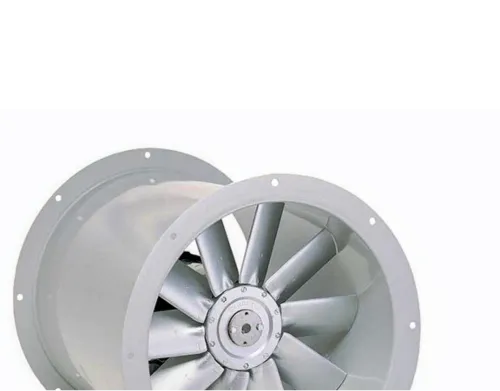
 | Belt Driven Tube Axial Flow Fan Axial Flow Fan – Modern Industrial Equipment Required For Cooling And Air Supply Needs An Axial flow fan takes in air parallel to the axis of blades... View product → |