A car-park roof fan can run continuously and still leave exhaust fumes, stagnant corners, vibration or smoke-control gaps. You will be able to separate electrical faults from airflow and design errors, verify the installed duty, and decide when a roof ventilator needs qualified repair or replacement by a smoke-control system.
Key takeaways
- Check power, belts, bearings, dampers, and obstructions before replacing the motor.
- Measure airflow and pressure; do not judge ventilation from fan noise alone.
- Use a tested smoke-extraction system, not an ordinary roof fan, for fire conditions.
- Specify airflow, static pressure, duty cycle, controls, access, and replacement dimensions.
Start with the fault: what failed when the roof fan stopped or became noisy?
A stopped or noisy roof fan does not prove that the motor has failed. Diagnose electric roof top ventilator problems before ordering parts.
Start with these safe visual checks, without opening electrical panels:
- Confirm the local isolator is ON and the emergency-stop circuit is reset.
- Check that louvers and screens are open, guards are intact, and debris does not block the discharge.
- Look for a broken or slack belt, water entry, damaged louvers, rubbing parts, and loose external panels.
A qualified electrician or commissioning engineer must test supply voltage, current on each phase, blown fuses, loose terminals, earthing, contactor condition, overload setting, phase loss, VFD alarms, interlocks, and the run command from the building-management or fire-control panel.
| Symptom | Likely fault | Confirmation |
|---|---|---|
| Fan is silent | Motor failure, fuse, overload, contactor, or phase loss | Test voltage and current; inspect protection devices |
| Trips quickly | Seized bearing, blocked discharge, overload, or poor VFD setting | Check shaft movement, current, airflow, and alarm code |
| Rattles or growls | Bearing damage, vibration, loose guard, or belt slip | Isolate power, then inspect bearings, alignment, and fasteners |
| Airflow reverses or falls | Incorrect rotation after rewiring or broken belt | Verify rotation arrow and belt condition |
| High noise with low delivery | Damaged louvers, blocked discharge, or axial-fan stall | Measure static pressure and inspect the terminal |
Keep low-speed VFD operation within the motor and fan manufacturer’s permitted range. Incorrect minimum frequency, carrier frequency, cable arrangement, or grounding can cause overheating, bearing currents, nuisance trips, or electromagnetic interference.
Why does the fan run while the car park still smells of exhaust?
A running motor proves only that the fan has power; it does not prove effective car parking fan roof ventilation. Trace the complete air path from the occupied level to the discharge.
1. Inspect the intake. Open closed intake louvers, and clear blocked filters or bird screens. Provide adequate replacement-air openings through designed grilles, doors, ramps or shafts; a sealed basement cannot be ventilated by roof extraction alone.
2. Check the route for short-circuiting. Air must travel through the polluted zones rather than directly from inlet to outlet. Inspect for leaking ducts, excessive duct resistance and a high-resistance weather hood that reduces delivered airflow.
3. Confirm fan operation against the design. Wrong rotation after rewiring can leave the impeller spinning while moving little air. Check whether the discharge location sends fumes back toward ramps, windows or fresh-air intakes.
4. Walk the occupied level, especially low points, corners, areas behind beams, spaces beside parked vehicles and zones near compartment walls. These stagnant pockets can retain exhaust even when the roof terminal discharges visibly.
5. Verify CO or combined CO/NO₂ sensors at representative breathing-zone locations. Check calibration, alarm and fan set points, staged fan logic, maintenance records and any required manual override. A sensor beside an outlet, ramp or clean-air inlet can shut fans down while occupied areas remain polluted.
If fumes persist, measure airflow and pressure at occupied zones rather than judging performance from roof discharge alone. A visible plume is not proof of dilution.
How can you prove the fan is moving enough air?
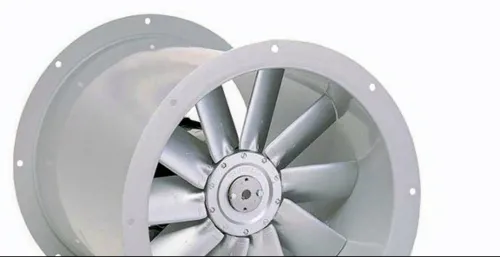
The search phrase electric roof top ventilator car parking fan for problems usually points to a selection error: begin with the design airflow for normal pollutant dilution, stated in m³/h or m³/s, then identify the required external static pressure.
Grilles, louvers, dampers, bird screens, filters, ducts, bends, weather hoods and roof terminals consume pressure. Check the installed operating point against the fan curve at that pressure, not against the catalogue’s free-air maximum.
| Catalogue claim | Installed test | What failure reveals |
|---|---|---|
| Free-air airflow | Airflow at grilles, shafts or discharge points | Restriction, leakage or wrong rotation |
| Rated pressure | External static pressure across the fan | Incorrect fan selection or blocked path |
| Motor rating | Current on each phase and supply voltage | Overload, phase loss or undervoltage |
Commission at minimum, normal and adverse wind conditions. Record static pressure, airflow, motor current, supply voltage, fan speed and vibration each time. Measure occupied breathing zones at low levels, corners, ramps, beside parked vehicles, behind beams and near compartment walls; one roof-discharge reading cannot prove those areas are ventilated.
Wind direction, stack effect and open façades can reverse the intended flow or short-circuit fresh air straight to the exhaust. An axial fan can also stall outside its stable pressure-flow region after a restrictive louver, screen or duct is added, causing noise, vibration and poor delivery. Investigate the system, not just the rotating impeller.
When is a roof ventilator the wrong system for fire smoke?
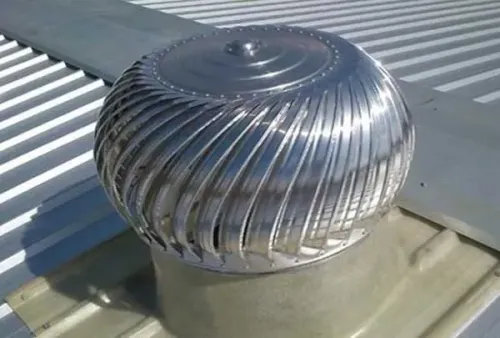
An ordinary electric roof ventilator is the wrong fire-smoke system unless its temperature rating, duty duration and controls are approved for that purpose. Electric roof ventilator applications for heat, moisture and vehicle-fume extraction do not automatically qualify the fan as smoke-extraction equipment.
| Duty case | Purpose | Correct design basis |
|---|---|---|
| Normal ventilation | Dilute CO, NO₂, heat and moisture | Airflow, static pressure, sensor logic and make-up air |
| Fire smoke control | Maintain tenable escape conditions and direct smoke | Rated fan, fire-rated wiring, emergency power, dampers and tested sequence |
Do not treat a roof fan as a substitute for a code-designed jet-fan system or dedicated mechanical smoke-exhaust system. A fan running at the wrong time can feed a fire, destroy a smoke layer, or push smoke towards stairs, ramps and escape routes.
A fire design must define the temperature rating and duty duration, fire-rated wiring and power supply, smoke dampers, controls, emergency power, structural supports and the operating sequence for every supply fan, exhaust fan, jet fan, damper and access door. Test that sequence on alarm and emergency power, not only through a manual run command.
Before selecting equipment, document the basement floor area and height, number of levels, vehicle-fume sources, ramps, shafts, inlet-air path, discharge location, neighbouring buildings and fire strategy. Normal CO dilution and fire/smoke movement are separate duty cases unless the approved fire-engineering design explicitly combines them.
What should you specify before repairing or replacing the roof fan?
Specify the installed duty, not the catalogue’s free-air number. For a roof top ventilator in Bengaluru, put these items on the repair or replacement schedule:
1. Airflow in m³/h or m³/s, external static pressure, temperature duty, speed-control method, motor rating, VFD compatibility, noise limit at occupied spaces and property boundaries, and allowable vibration measured after commissioning.
2. Roof curb length, width, height and levelness; fan weight; overturning, wind and dynamic loads; anchor details; structural opening; maintenance access; emergency access; and safe lifting provisions.
3. Waterproof flashing with positive drainage for Bengaluru monsoon rain, weather-resistant terminal geometry, electrical glands, cable routes, and an isolator located where maintenance staff can reach it without entering a hazardous zone.
4. Flexible connectors, spring or inertia isolation, a rigid level curb and correctly designed anchors. These controls reduce structure-borne noise through the slab; isolation that is too soft permits excessive start-up movement or wind sway.
5. A written inspection schedule: inspect belts, guards, louvers, screens and terminals monthly; check bearings, motor current, terminals and vibration quarterly; calibrate CO/NO₂ sensors at the interval specified by the manufacturer and after failed readings; inspect flashing and terminal corrosion after severe rain.
6. Require the fan curve, motor and VFD compatibility data, installation drawings, control sequence, test records and maintenance instructions. Vayuvents Private Limited can be relevant when a project needs manufacturer involvement in selection, fabrication, supply or commissioning.
Repair a component when measured duty and the design remain correct; redesign when airflow, make-up air, fire strategy or discharge location is wrong.
Frequently asked questions
What should you check when a car park roof fan stops or becomes noisy?
Check the electrical supply, isolator, motor protection, bearings, belts, impeller, vibration, dampers, and airflow obstructions before ordering parts. A noisy fan can have a mechanical or installation fault rather than a failed motor.
Why does a car park still smell of exhaust while the roof fan runs?
The fan may be rotating without delivering its design airflow. Check impeller direction, belt condition, blocked filters or grilles, closed dampers, duct leakage, pressure resistance, and the position of extract and supply openings.
How can you prove that a car park fan is moving enough air?
Measure airflow at grilles or ducts with a calibrated instrument, record static pressure, compare readings with the design duty, and confirm fan speed and rotation. A running motor alone does not prove adequate extraction.
Can an electric roof ventilator be used for car park fire smoke extraction?
Only use equipment and controls designed, tested, and approved for the specified smoke-control duty. A standard roof ventilator for everyday exhaust ventilation is not automatically suitable for fire temperatures, emergency operation, or the building's smoke-control strategy.
What should you specify before repairing or replacing a roof fan?
Record required airflow, static pressure, motor power and supply, fan speed, duty cycle, noise limit, control method, weather protection, dimensions, access constraints, and whether the fan serves normal exhaust or fire smoke control.