Heat, fumes, humidity and odours often collect near the roof when natural ventilation cannot remove them fast enough. You will learn how roof extraction works, when it is the wrong solution, how to estimate the required airflow, and which specifications to verify before choosing a fan.
Key takeaways
- Use roof fans for general extraction, not source capture of contaminants.
- Calculate airflow from room volume, heat load and required air changes.
- Check fan performance at system resistance, not free-air capacity.
- Verify roof curb, weather protection, noise, controls and commissioning records.
What a roof extractor fan does—and when a building needs one
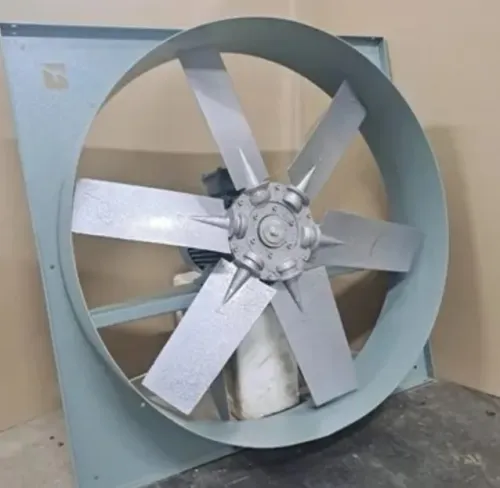
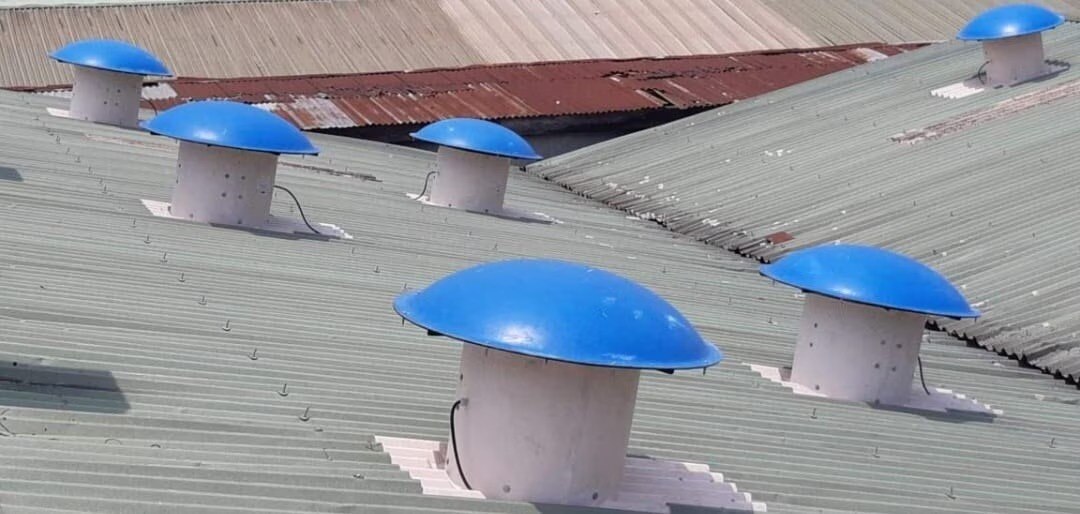
What is a roof extractor fan? It is a fan mounted over a roof curb or opening that removes building air and discharges it to the atmosphere. It suits general room extraction, not balanced ventilation or automatic capture of contaminants at their source.
| System | What it does | Main limitation |
|---|---|---|
| Extraction | Removes indoor air | Needs replacement air |
| Supply ventilation | Introduces outdoor air | Does not remove contaminated air by itself |
| Passive roof ventilation | Uses wind or temperature differences | Airflow varies with weather and roof design |
Plan a deliberate make-up-air path before installing extraction. Without replacement air, doors can slam, fan flow can fall, dusty air can enter through unintended routes, combustion appliances can backdraft, and separate exhaust systems can interfere with one another.
Investigate a roof fan when a building has persistent heat stratification, process fumes, humidity, odours, dust, or inadequate natural ventilation. These symptoms occur in factories, workshops, warehouses, packing rooms, and other enclosed process spaces.
A roof fan removes diluted room air. It does not replace local exhaust capture at a machine, tank, welding station, or workbench, where contaminants enter the air.
Use source capture as well for welding fumes, solvent vapour, dust, or highly toxic substances; relying only on roof extraction can leave workers breathing the contaminant before dilution occurs.
Roof extractor fan applications in factories, warehouses and process areas
Roof extractor fan applications are most useful when a building needs controlled general exhaust, not just an open door. Industrial roof fan uses include planned air changes in workshops, production halls, packing rooms and other process spaces.
1. In a factory workshop, hot air can collect beneath a high roof while workers occupy the lower level. A roof fan removes this stratified air and supports the planned air-change rate, provided cooler replacement air can enter.
2. In a warehouse, a large air volume can heat up for hours even with doors and wall openings available. A roof fan provides scheduled extraction instead of relying on doors that remain closed for security, dust control or material handling.
3. In a kitchen, general roof extraction removes diluted room heat and odour. It does not replace a correctly designed cooking hood, which must capture grease, vapour and combustion products at the appliance.
4. In a foundry, radiant heat from furnaces affects workers before room air becomes uniformly hot. Use local capture near furnace openings and pour points for concentrated fumes, then use roof extraction for residual heat and diluted air.
5. In a textile unit, extraction can reduce humidity and process heat. Protect the fan with suitable lint control and inspection access; accumulated lint can foul screens, coat impellers and reduce airflow.
6. In a chemical area, solvent vapour or toxic substances require compatible local exhaust, suitable construction materials and a safe discharge location. A roof fan removes diluted room air and cannot guarantee capture at the source.
How to calculate airflow and select the fan’s real operating capacity
Start with room volume: multiply length by width by clear height. If a room is 20 m long, 10 m wide and 6 m high, V is 1,200 m³. Estimate general ventilation with Q = V × N, where Q is airflow in m³/h and N is the required air changes per hour.
Divide Q by 3,600 to convert it to m³/s for fan-data comparisons.
Air changes are only a starting point. Contaminant type, release rate, worker position and capture distance determine whether local exhaust ventilation is necessary. A roof fan cannot replace a hood or source-capture arm for welding fumes, solvent vapour, dust or highly toxic substances.
Calculate resistance through the complete air path, including duct length, bends, louvers, filters, dampers, bird screens, roof terminals and fouling from dust or grease. Then compare fans at the required external static pressure, not at free-air airflow.
| Fan figure | What it tells you | Selection use |
|---|---|---|
| Free-air airflow | Output with little or no resistance | Do not use it as the duty point |
| Airflow at external static pressure | Delivered flow against system resistance | Use this for comparison |
| Fan curve and operating point | Flow and pressure where the fan will run | Confirm the point falls within the required duty |
Ask for the fan curve, operating point, motor speed, electrical supply, sound level and test basis. Confirm whether aerodynamic performance was measured to AMCA 210; a catalogue airflow without pressure and test information is not enough.
Which ventilation option fits the roof, climate and building layout?
Choose an electrically driven roof extractor when you need measured, adjustable airflow; choose passive ventilation only when the roof, climate and air movement can deliver enough change without controls.
| Option | Strength | Limitation |
|---|---|---|
| Electrically driven roof extractor | Controllable airflow for heat, humidity and dilution | Uses power and needs electrical protection |
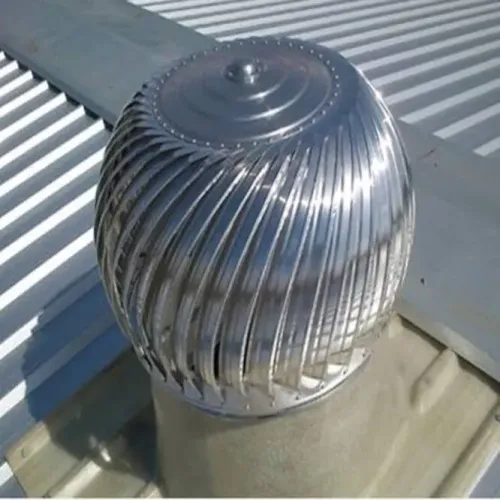
| Wind-driven turbine ventilator | Very low operating energy | Depends on wind, temperature difference and turbine condition |
| Ridge ventilation | Continuous passive discharge across a suitable ridge | Requires compatible roof design and adequate inlet air |
| Wall exhaust fan | Simple access and straightforward replacement | Can create short-circuit airflow between nearby inlet and outlet |
| Central HVAC or air-handling system | Adds filtration, heating, cooling and controlled make-up air | Higher installation, controls and energy costs |
Check the site before selecting any option:
- Record room volume, roof height, roof slope, roof curb dimensions and structural loading.
- Check roof drainage, flashing space, electrical supply, protected electrical entries and maintenance access.
- Confirm discharge direction and distance from air intakes, doors, windows and occupied areas.
For a roof extractor fan in Mumbai, design for monsoon rain, high humidity and airborne salt near the coast. Specify a weather-resistant discharge, sealed flashing, drainage that cannot pond at the curb, protected electrical entries, and corrosion-resistant or coated casing and fasteners.
Arrange inspection access after heavy rain; an outdoor-rated casing alone does not make the roof penetration rain-tight. In hot-humid weather, extraction can also draw in moisture, so use conditioned make-up air when comfort matters.
What to verify before buying, installing and commissioning a roof fan
A 23 roof extractor fan usually means a nominal 23-inch fan size, not a complete performance specification. Confirm the following before treating two models as equivalent:
- Actual impeller or roof-opening diameter
- Airflow at the required external static pressure, not free-air airflow
- Fan curve, operating point, motor speed, voltage, phase and duty class
- Sound level and test basis, including AMCA 210 where claimed
- Casing material, weatherproof terminal, bird screen and maintenance access
- Direct-drive or belt-drive arrangement
Direct-drive fans simplify servicing and avoid belt replacement, while speed control depends on motor and controller compatibility. Belt-drive fans allow pulley changes and broader speed adjustment, but require belt tensioning, alignment and bearing maintenance.
Check the roof curb strength, vibration isolation, flashing, drainage and rain-tight electrical entry before installation. An outdoor-labelled casing does not prove that the roof penetration or terminal will exclude wind-driven rain. Vayuvents Private Limited can help match fan duty to roof details and operating conditions when the purchase request demands documented performance.
For dusty or greasy exhaust, inspect monthly and begin with quarterly cleaning; shorten the interval when deposits appear. Corrosive exhaust needs a material review and frequent inspection. Deposits cause imbalance, bearing damage, blocked screens and declining airflow.
Ordinary ventilation is not smoke-control extraction. Life-safety service requires documented fire rating, controls, standby power, fire-alarm interface and commissioning evidence.
| Arrangement | Speed control | Service burden |
|---|---|---|
| Direct-drive | Controller-dependent | No belts; motor and bearings remain accessible |
| Belt-drive | Pulley or inverter options | Inspect belts, pulleys, alignment and bearings regularly |
Related products
 | Get A Clean Environment With Electrically Operated Roof Extractor Fan Electrically Operated Roof Extractor Fan is a device that takes in air from... View product → |
 | Roof Ventilation Fan Vayuvents Private Limited manufacturing and exporting high quality Roof Exhaust Fan worldwide. |
Frequently asked questions
What is a roof extractor fan?
A roof extractor fan mounts over a roof curb or opening and removes building air to the atmosphere. It provides general room extraction rather than balanced ventilation or automatic contaminant capture at the source.
Where are roof extractor fans used?
Roof extractor fan applications include factories, warehouses, process areas and other buildings that need heat, humidity, fumes or stale air removed from the general space.
How do you calculate the airflow for a roof extractor fan?
Start with the room volume and required air changes per hour, then check heat, moisture and contaminant loads. Select the fan using its airflow at the system’s actual resistance, including grilles, dampers, ducts and roof weather protection.
What should you verify before installing a roof fan?
Verify the roof curb and opening dimensions, structural support, weather sealing, discharge clearance, noise limits, electrical supply, controls, access for maintenance and measured airflow during commissioning.
Related products
 | The efficiency of Conventional Ventilators is dependent on wind velocity. View product → |
 | Roof Ventilator Motorized Roof Ventilation Fans Vayuvents Private Limited manufacturing and exporting high quality Motorized Roof Exhaust Fans worldwide. |
 | Roof Ventilator Electric Roof Top Ventilator Vayuvents Private Limited is India’s leading Industrial Electric Ventilator exporters. |