A fog cannon and a roof fan are not interchangeable: one wets airborne dust in an open area, while the other exhausts building air and depends on replacement air. By the end, you will be able to match the equipment to the pollutant, emission point, weather exposure, airflow requirement, and operating risks at a Mumbai factory.
Key takeaways
- Use an anti-smog gun for exposed dust; use roof fans for contaminated indoor air.
- Control dust at its source before sizing ventilation equipment.
- Allow for Mumbai’s monsoon humidity, wind, and roof heat when comparing options.
- Calculate required airflow from room volume, pollutant source, and target air changes.
Dust suppression and air extraction solve different problems
An anti smog gun versus roof ventilation fan in Mumbai comparison starts with the pollutant’s location: a water cannon treats exposed dust, while a roof fan removes contaminated building air. They are not interchangeable.
| Option | What it does | Pollutants and limits |
|---|---|---|
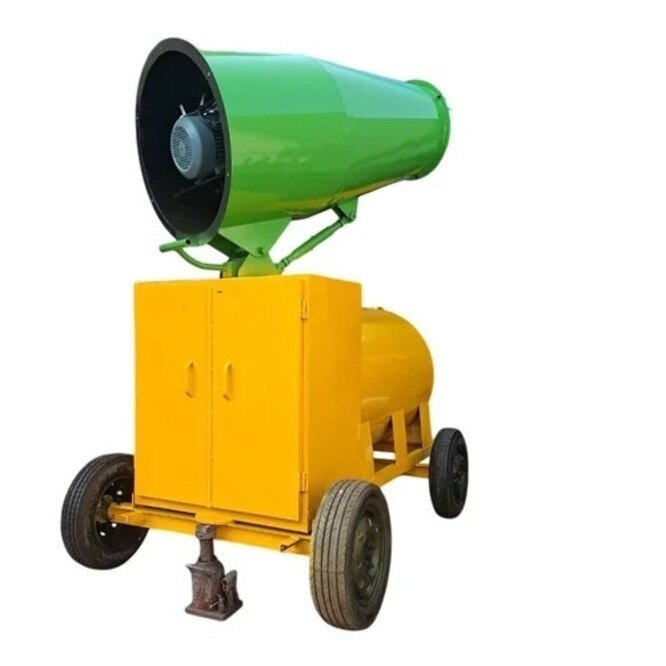
| Anti-smog gun | Atomises water so airborne particles agglomerate, settle, or remain wet | Controls coarse and fine dust in open yards, stockpiles, haul roads, and demolition areas. It does not capture welding fumes, solvent vapours, combustion gases, or process heat. |
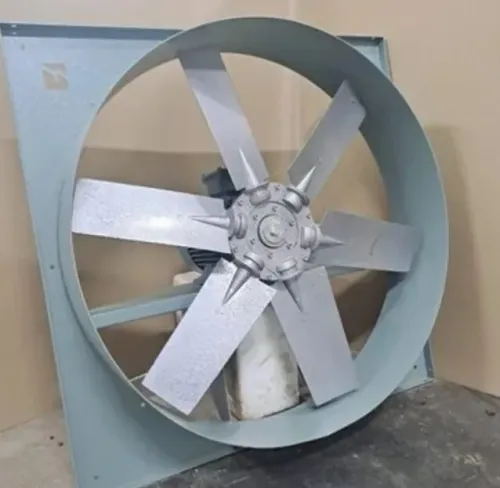
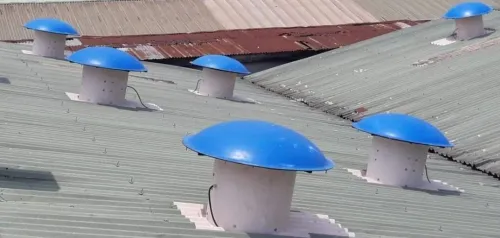
| Roof ventilation fan | Exhausts hot or contaminated air and draws replacement air through louvers, doors, or dedicated inlets | Removes heat and dilutes airborne dust, fumes, and gases after they enter the building. It does not collect particles, and it is weak against a concentrated plume. |
The industrial roof ventilation comparison must therefore include airflow, make-up air, static pressure, noise, rain protection, corrosion, and maintenance access—not just fan diameter or motor power. A roof fan can also spread contamination through the building before exhaust reaches the roof.
Choose water suppression only when wetting will not damage products, electrical equipment, or corrosion-sensitive machinery. In Mumbai’s humidity and monsoon, check drainage, slip hazards, nozzle blockage, pump protection, microbial growth, and salt corrosion. Use local exhaust at mixers, grinders, bag-dumping points, welding stations, furnaces, paint booths, and chemical vessels.
Match the equipment to the source, not the symptom
Choose equipment by where the contaminant enters the air. An anti smog gun in Mumbai suits an exposed dust source; it is not a substitute for capturing emissions beside workers.
| Option | What it does | When it applies |
|---|---|---|
| Anti-smog gun | Uses atomised water to wet and agglomerate airborne particles | Open yards, haul roads, stockpiles, demolition zones, and other outdoor dust sources |
| Roof ventilation fan | Exhausts hot or contaminated air and relies on replacement air | General heat buildup and dilute background contamination across a building |
| Local exhaust | Captures dust, fumes, or vapour at the release point | Mixers, grinders, bag-dumping stations, welding points, furnaces, paint booths, and chemical vessels |
| Combined arrangement | Captures at the process, exhausts residual heat, and suppresses outdoor dust | A factory with both enclosed emissions and exposed yard dust |
A roof ventilation fan in Mumbai cannot collect particles at a grinder or remove welding fumes before workers breathe them. Section 14 of the Factories Act, 1948 supports applying exhaust appliances as near as practicable to the point of origin.
Use water suppression only where wetting will not damage stock, corrode equipment, raise humidity, or create slippery floors and drainage problems. Keep it away from hygroscopic dust, electrical gear, and corrosion-sensitive machinery unless drainage and water treatment are designed.
Check interactions in a combined system: a roof fan can pull fog, humid air, or outdoor pollution through poorly placed openings. Ensure make-up-air inlets do not sit beside the spray zone or exhaust discharge.
Mumbai weather changes the operating trade-offs
Monsoon rain changes the operating equation for both choices. An anti-smog gun in Mumbai needs reliable water, protected pumps, clear drainage, and nozzles that will not clog with poor-quality water. A roof ventilation fan in Mumbai needs a rain hood, sealed roof penetrations, corrosion-resistant fixings, and waterproofing that survives repeated wetting.
| Weather condition | Anti-smog gun | Roof ventilation fan |
|---|---|---|
| Monsoon rain | Wet ground, blocked drains, and spray runoff can create slips; rain can also scatter the mist. | Wind-driven rain can enter through the fan unless the hood and flashing are correctly designed. |
| High humidity | Adds moisture to the building, encouraging corrosion, microbial growth, and hygroscopic dust deposits. | Removes hot, contaminated air but does not dry the space; provide enough make-up air for the intended airflow. |
| Salt-laden air | Salts attack pumps, nozzles, electrical parts, and painted steel; specify corrosion-resistant materials. | Salts attack fan housings, motors, bearings, fasteners, and roof supports; schedule washing and inspection. |
| Wind and dense surroundings | Crosswind can carry droplets away from the dust source, while nearby buildings alter the spray pattern. | Wind can reduce exhaust performance or drive discharge back toward doors and air intakes; check clearances and discharge direction. |
Do not judge either quotation by throw distance or fan diameter alone. Check the gun’s droplet distribution, water treatment, drainage, nozzle access, and local service; check the fan’s delivered airflow at static pressure, roof loading, noise, and make-up-air openings.
Calculate the airflow before choosing a roof fan
A roof fan sized by diameter or motor horsepower can still fail to remove contaminated air. Measure the factory’s length, width and clear height to calculate volume, then record heat load, contaminant generation rate, outdoor background concentration and the indoor concentration limit.
For a well-mixed dilution estimate, use Q = G ÷ (Ci − Co), where G is contaminant generation, Ci is the allowable indoor concentration and Co is the outdoor concentration; keep all units consistent.
Check the following before selecting the fan:
- Measure existing airflow with the process running, using an anemometer or calibrated airflow hood at roof outlets and make-up-air openings.
- Map pressure and airflow direction around furnaces, welding stations, chemical processes and worker positions. A roof fan that pulls fumes across workers has failed, even if its measured volume is correct.
- Calculate heat-removal airflow from the heat balance and permitted indoor-to-outdoor temperature difference; do not use air changes per hour alone.
- Read the fan curve at the system’s actual static pressure, including louvers, screens, filters and ductwork.
- Confirm make-up air equals the exhausted volume without drawing rain, fog or outdoor pollution into occupied areas.
| Option | Airflow basis | Main limitation |
|---|---|---|
| Roof exhaust | Heat balance plus dilution Q | Weak for concentrated plumes |
| Local exhaust | Capture velocity at the source | Requires hoods and duct maintenance |
| Combined system | Source capture plus residual heat airflow | Poor intake placement can spread contamination |
This industrial roof ventilation comparison also needs noise, roof loading, waterproofing, corrosion, electrical classification and maintenance access. For factory air pollution control in Mumbai, test delivered airflow and pressure during production, not from a catalogue demonstration.
Use testing and procurement checks to make the final decision
Compare quotations at the operating point, not by fan diameter, motor horsepower, or spray range alone. For factory air pollution control in Mumbai, require each supplier to state delivered airflow, static pressure, power, noise, corrosion protection, maintenance access, and make-up-air assumptions.
| Option | Verify in quotation | Reject if |
|---|---|---|
| Anti-smog gun | Water flow, droplet/nozzle specification, coverage at wind speed, pump protection, drainage, monsoon operation | No water quality, blockage, runoff, or electrical protection details |
| Roof ventilation fan | Airflow at static pressure, rain and wind protection, roof loading, noise, corrosion resistance, inlet area | Airflow is stated only as free delivery |
| Combined system | Local-capture flow, roof-exhaust flow, intake locations, controls, and interaction test | Exhaust draws spray, humid air, or outdoor pollution across occupied areas |
Before purchase, ask for a witnessed commissioning test. Measure fan airflow and static pressure, verify water flow and nozzle coverage, use smoke to confirm that contaminated air travels toward the capture point, and record noise at worker positions.
A supplier such as Vayuvents Private Limited should be asked to put these figures and test methods in the quotation, not leave them to verbal assurances.
Choose local exhaust for a mixer, grinder, welding point, chemical vessel, or enclosure. Add roof exhaust for heat and diluted background contamination. Use an anti-smog gun for an open yard or stockpile only when water, drainage, product protection, and humidity controls are acceptable.
This is the practical test for anti smog gun versus roof ventilation fan in Mumbai.
Related products
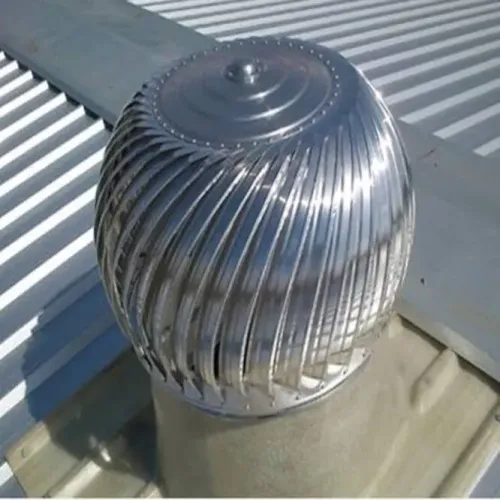
 | The efficiency of Conventional Ventilators is dependent on wind velocity. View product → |
 | Get A Clean Environment With Electrically Operated Roof Extractor Fan Electrically Operated Roof Extractor Fan is a device that takes in air from... View product → |
Frequently asked questions
What is the difference between dust suppression and air extraction?
An anti-smog gun wets and suppresses exposed dust outdoors. A roof ventilation fan removes hot or contaminated air from inside a factory; it does not capture settled dust at its source.
How do you choose equipment for a factory air problem?
Identify where the pollutant is released. Select source capture or dust suppression for the release point, then use roof ventilation for heat and general indoor air exchange.
How does Mumbai weather affect the equipment choice?
Monsoon humidity can slow evaporation and create wet-floor risks for water-based suppression. Wind affects spray drift, while humid outdoor air reduces the drying advantage of roof ventilation.
How do you calculate airflow before choosing a roof fan?
Calculate room volume in cubic metres, choose a target air-change rate, multiply the two, and then account for fan pressure losses, louvers, ducts, filters, and roof openings.
What should you check before buying or commissioning the equipment?
Request airflow and pressure test results, motor and electrical details, noise data, corrosion protection, maintenance access, warranty terms, and commissioning records.
Related products
 | We are indulged in exporting, manufacturing, distributing and supplying the Smoke and Fume Exhauster Cum Air Blower in Ahmedabad, Gujarat, India. View product → |
 | We are one of the prominent manufacturers and suppliers of a complete Fume Extraction System that includes design, manufacturing, commissioning and... View product → |
 | Motorized Roof Ventilation Fans Vayuvents Private Limited manufacturing and exporting high quality Motorized Roof Exhaust Fans worldwide. |
 | Roof Ventilator Electric Roof Top Ventilator Vayuvents Private Limited is India’s leading Industrial Electric Ventilator exporters. |