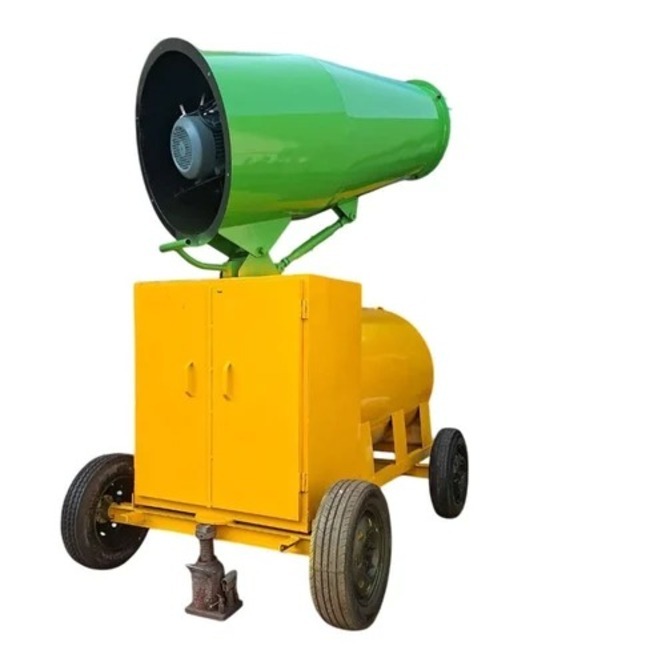
Dust generated at construction sites, demolition areas, material yards and other open operations can spread quickly when fine particles become airborne. An Anti Smog Gun uses atomised water droplets projected over a defined area to help suppress suitable airborne dust.
However, machines vary in throw distance, water consumption, droplet characteristics, mounting arrangement and operating controls. Businesses evaluating an anti smog gun in Bengaluru should therefore compare the application requirements rather than focusing only on maximum throw distance.
1. Identify the Dust Source
Start by understanding where the dust originates.
A stationary stockpile may require a different arrangement from a large construction area or frequently changing demolition zone. The equipment should be positioned so that the mist reaches the area where airborne dust needs to be controlled.
Wind direction and site layout also affect placement.
2. Evaluate Effective Coverage
Throw distance is useful, but it should not be the only selection criterion.
Consider the horizontal movement, vertical adjustment and rotation range of the machine. A unit that reaches a long distance in one direction may still require repositioning if the operating area is wide or irregular.
Ask how the stated coverage relates to realistic operating conditions.
3. Check Water Availability
Anti smog guns depend on an adequate water supply.
Before procurement, determine:
Available water pressure
Water quality
Water source
Required flow rate
Storage requirements
Drainage conditions
Expected daily operating hours
Where water quality is poor, nozzle maintenance may become more frequent.
4. Review Droplet Formation
Dust suppression depends partly on the interaction between airborne particles and water droplets.
Extremely large droplets may fall quickly, while very fine droplets may behave differently under windy conditions. The nozzle arrangement and operating pressure should be suited to the intended dust-control application.
5. Check Mobility Requirements
Some sites need a fixed dust-suppression point. Others require equipment to move as work progresses.
Depending on the application, buyers may evaluate skid-mounted, trolley-mounted or other installation arrangements. Accessibility for water and electrical connections should be considered when mobility is required.
6. Ask About Maintenance
Nozzles are important components of a misting system and should remain clean for consistent spray performance.
Maintenance planning should include checking:
Nozzles
Pumps
Filters or strainers
Hoses
Electrical components
Rotation mechanisms
Structural mounting
Easy access can reduce the time required for routine servicing.
7. Assess Site-Specific Requirements
Bengaluru construction and industrial sites can experience changing weather and operating conditions. An anti smog gun should form part of a broader dust-management approach based on the actual source and site conditions.
Vayuvents Private Limited provides industrial air and dust-control equipment for applications in Bengaluru. Before finalising an anti smog gun, buyers should share the approximate site area, dust source, desired coverage, water availability and operating schedule.
The right buying decision is not simply the machine with the longest advertised range. Effective dust suppression depends on appropriate placement, spray characteristics, available water and operating practices. Comparing these factors provides a more useful basis for selecting equipment for Bengaluru and other locations across Karnataka.