An anti-smog gun produces a water mist; it does not define the exhaust stream a packed scrubber must treat. By the end, you will be able to map the capture point, identify every major scrubber component, specify the airflow and chemistry, and compare supplier quotations without sizing the system from the gun’s water-flow rating.
Key takeaways
- Connect the scrubber to a hood or enclosure, not a free-standing outdoor mist gun.
- Specify airflow, contaminant loading, pressure drop and outlet limits before requesting quotes.
- Ask for packing depth, liquid-to-gas ratio, pump duty and mist-eliminator details.
- Require commissioning data with inlet and outlet measurements, test methods and operating conditions.
First define the air stream: the gun, capture point and process flow
An anti-smog gun is a water-mist dust-suppression device, not a defined industrial exhaust source. A free-standing gun spraying outdoors is neither a substitute for source capture nor an efficient connection to a fixed packed tower; use a hood, enclosure or ducted collection point.
1. Define the captured stream at the enclosure or exhaust point. Record gun air volume, number of guns, simultaneous operating count, capture distance, gas temperature, dust loading, particle-size distribution and contaminant concentration. For a packed wet fume scrubber for anti smog gun in Mumbai, these values—not the gun’s water-flow rating—form the design basis.
2. Confirm the connection. The gun outlet connects to the scrubber only when it is a ducted air source; otherwise, capture the process air around the gun with a hood or enclosed outlet.
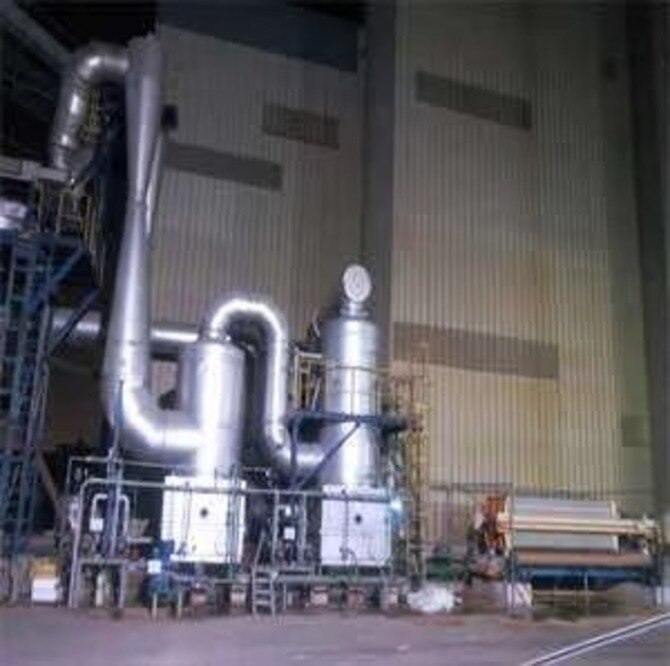
3. Map the process flow: capture hood or enclosed anti-smog-gun outlet, inlet duct, pre-separator if dust loading requires it, packed tower, mist eliminator, induced-draft fan and stack. The mist eliminator limits droplets reaching the fan and discharge.
4. Match capacity to the total simultaneous gun air volume, then add measured duct leakage and a stated future-expansion allowance. Specify duct velocity as well: excessive velocity raises pressure loss and erosion, while low velocity allows dust to settle before the tower.
5. Select the fan after calculating losses through the duct, bends, pre-separator, packed bed and mist eliminator. A fan chosen only from the gun’s air-volume figure can fail to maintain capture.
What the packed wet fume scrubber physically includes
A complete installation is more than a tower shell. It includes the equipment that moves gas, circulates liquid, removes droplets, permits inspection and controls discharge.
- The vertical packed tower contains the random packing bed. A packing support grid carries that bed while passing gas and liquid; a hold-down grid prevents movement during surges.
- A liquid distributor, supplied by spray headers or nozzles, must irrigate the entire bed at minimum design flow. Ask for nozzle plugging access and coverage details.
- The recirculation sump, pump and suction strainer return liquor through the bed. Include a drain, overflow and make-up-water connection.
- A demister or mist eliminator limits droplets reaching the fan and stack. Specify wash arrangements, clean-out access and replacement clearance.
- Include access doors, inspection ports, inlet and outlet ducting, differential-pressure taps, pH or conductivity points, an induced-draft fan, stack, isolation dampers and controls.
- Provide enough maintenance clearance around the pump, nozzles, demister and access doors.
| Scope | What it includes | What goes wrong if omitted |
|---|---|---|
| Vessel-only quotation | Tower shell, packing and basic internals | Dry zones, channeling or a restricted support grid can defeat a large packing volume |
| Complete installation | Tower, liquid circuit, demister, ducting, fan, stack, instruments and controls | The system can be inspected, adjusted and maintained as specified |
These items belong in the wet fume scrubber specifications. Confirm that the support grid does not create major pressure loss and that the demister suits gas velocity, droplet loading and salt deposits. A vessel quotation is incomplete without these details.
The numbers that make a scrubber specification usable
Put these numbers into the wet fume scrubber specifications; a vessel diameter or fan capacity alone cannot define performance.
- State design airflow in m³/h at operating temperature and pressure, minimum and maximum turndown flow, inlet temperature, relative humidity, pollutant species, inlet concentration, and guaranteed outlet concentration or removal efficiency.
- Calculate gas capacity as gun air volume multiplied by the number of guns running simultaneously. Add measured duct leakage and a stated expansion allowance; never treat water consumption as gas flow.
- Specify tower diameter and height, packing type, nominal size and depth, liquid-to-gas ratio, pump flow and head, allowable pressure drop, demister type, and fan motor rating.
- Select the fan after adding packed-bed, demister, duct, bend, filter, and pre-separator losses. State the operating pressure-drop range and expected operating hours.
- Include differential-pressure taps and a local or remote gauge. Rising pressure at unchanged airflow indicates flooding, fouling, salt deposition, or demister blockage; an unexpectedly low reading points to bypassing, dry packing, or lost packing.
Use this as the core of a packed scrubber buying guide. The datasheet must also identify liquid chemistry and the test conditions for any efficiency guarantee, because packing height cannot compensate for inadequate irrigation or a fan selected only from the anti-smog gun’s air-volume figure.
Choose the liquid, pre-treatment and Mumbai installation details
Use water for soluble dust and gases; use an alkaline liquor such as sodium hydroxide for acidic gases. Control pH, blowdown and make-up water. Water scrubbing is a poor answer for hydrophobic gases, non-soluble particles and some VOC vapours.
| Liquid choice | Use it for | Control required |
|---|---|---|
| Water | Soluble dust and gases | pH, conductivity or TDS, blowdown |
| Sodium hydroxide liquor | Acidic gases | Controlled pH, reagent strength, blowdown |
| Neither alone | Hydrophobic gases, insoluble particles and some VOC vapours | Select adsorption, oxidation or particulate control |
A packed tower is principally a gas-absorption device. Put a cyclone, spray chamber, venturi stage, mesh filter or cartridge collector upstream of a dust-heavy stream; otherwise packing blockage, pump abrasion and rising pressure drop follow. The pre-treatment choice depends on particle size, loading and abrasiveness.
Specify pH or ORP, conductivity or TDS, drain capacity, make-up-water flow and who handles wastewater. Absorbed gases, dust and salts change recirculation water, causing scale, corrosion or biological growth if blowdown is neglected. This belongs in any packed scrubber buying guide.
For a packed wet fume scrubber for anti smog gun in Mumbai, provide weather protection for controls, monsoon drainage, safe outdoor access and maintenance space around the vertical tower, pump and doors.
Match FRP, polypropylene, PVC, stainless steel, rubber-lined steel or coated carbon steel to actual acid, chloride, oxidant, solvent, abrasion and temperature exposure—not to the word “wet” alone.
How to compare a supplier quotation and prove performance
A quotation from an industrial wet scrubber supplier in Mumbai is incomplete if it prices only the tower. Request these documents and design details before comparing totals:
- Wetted-material schedule for the tower, packing, distributor, pump, piping, nozzles, demister frame and fasteners
- General arrangement drawing showing maintenance access, drains, inspection points and clearances
- Pump and fan curves, nozzle coverage, packing depth, pressure-drop allowance and blowdown rate
- Emergency bypass logic, including interlocks, isolation dampers and safe discharge
- Local service scope covering commissioning, alignment, spares, wastewater guidance and response time
Compare quotations against the same evidence:
| Supplier evidence | What it proves | Reject if missing |
|---|---|---|
| Pollutant-specific guarantee | Names pollutant, particle-size basis, inlet loading, gas flow and test method | “99% efficiency” appears without these conditions |
| Acceptance protocol | Defines airflow, pressure drop, liquid circulation, pH or reagent concentration, sampling, duration and operating limits | Performance depends on an undefined site trial |
| Service schedule | Includes commissioning measurements, pump and fan alignment, spare nozzles, demister pads and packing replacement instructions | Price covers fabrication but not start-up support |
Put the acceptance protocol in the purchase order. Require inlet and outlet sampling at the stated points, measured airflow and pressure drop, and results under the anti-smog-gun operating schedule.
Vayuvents Private Limited can be compared with other suppliers on this service scope, not fabrication price alone; the completed installation must demonstrate capture, treatment and safe discharge. A practical packed scrubber buying guide also checks wastewater responsibility and the supplier’s emergency response time.
Frequently asked questions
Can a packed wet scrubber connect directly to a free-standing anti-smog gun?
No. A free-standing gun is a water-mist dust-suppression device, not a defined exhaust source. Use a hood, enclosure or ducted collection point that delivers a measured air stream to the scrubber.
What numbers belong in a packed wet scrubber specification?
State design airflow, gas temperature, contaminant type and concentration, required outlet limit, pressure drop, liquid circulation rate, packing depth, pump duty and mist-eliminator design.
What liquid and pre-treatment does a packed scrubber need?
Choose water or a reagent based on the contaminant chemistry. Add a settling tank, strainer or other solids-removal stage when dust, sludge or sticky material could block the pump, nozzles or packing.
How can you compare wet scrubber supplier quotations?
Compare each quotation against the same airflow, contaminant load, outlet target, pressure-drop limit, materials, instruments, exclusions and commissioning test plan. Require measured inlet and outlet results under stated operating conditions.